Site map and visualisations
The classic site map for reports and the 2D / 3D exploration view - crawl tree, directories, link graph, filters, inspector, exports.
Two views, one data set
After a crawl, the sidebar offers two complementary tabs that share the same data, filters, search and page inspector, and each remember their own settings:
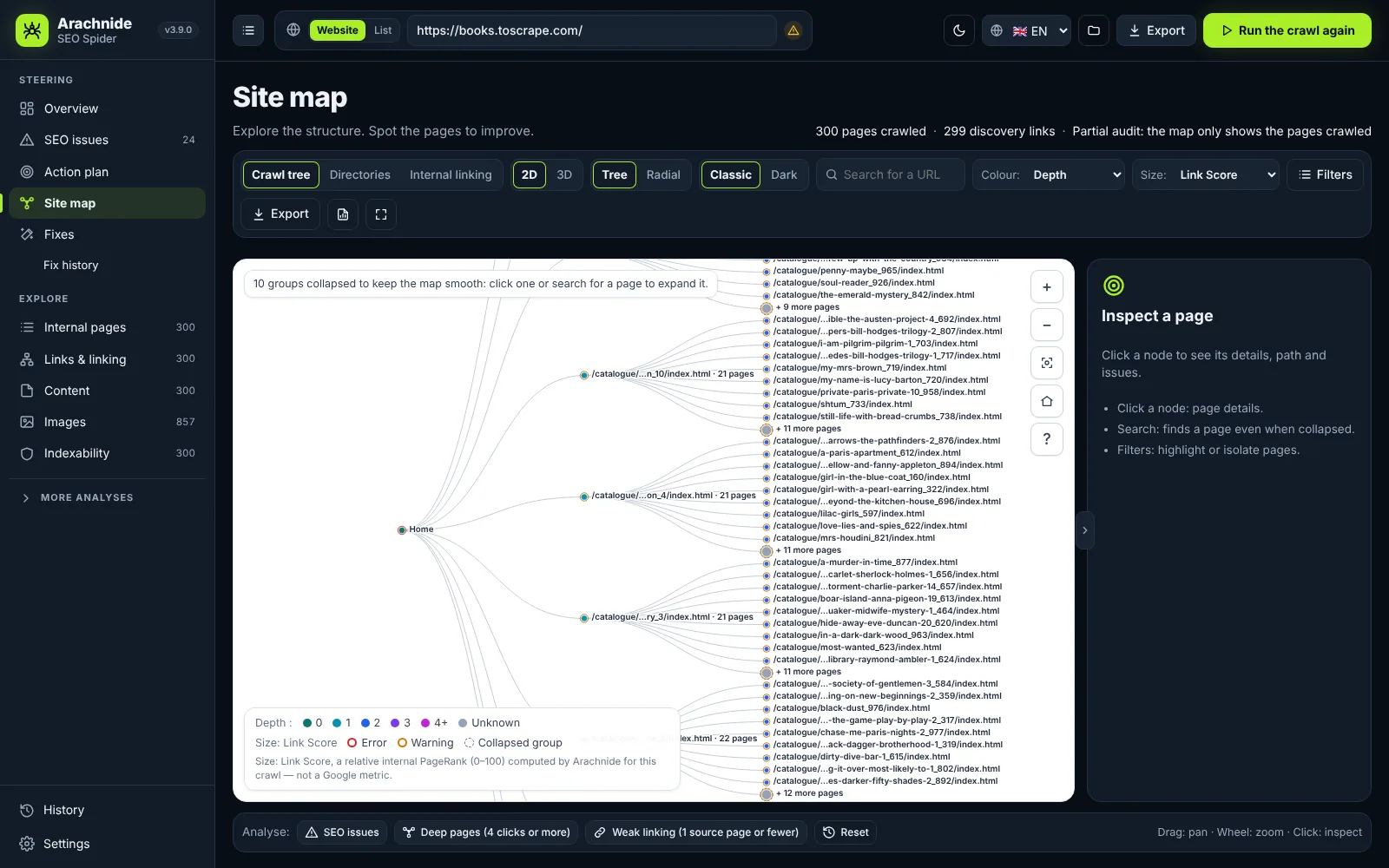
- Site map: the classic, Screaming Frog-style map. White background, thin links, dark labels, horizontal tree, made for screenshots and client reports.
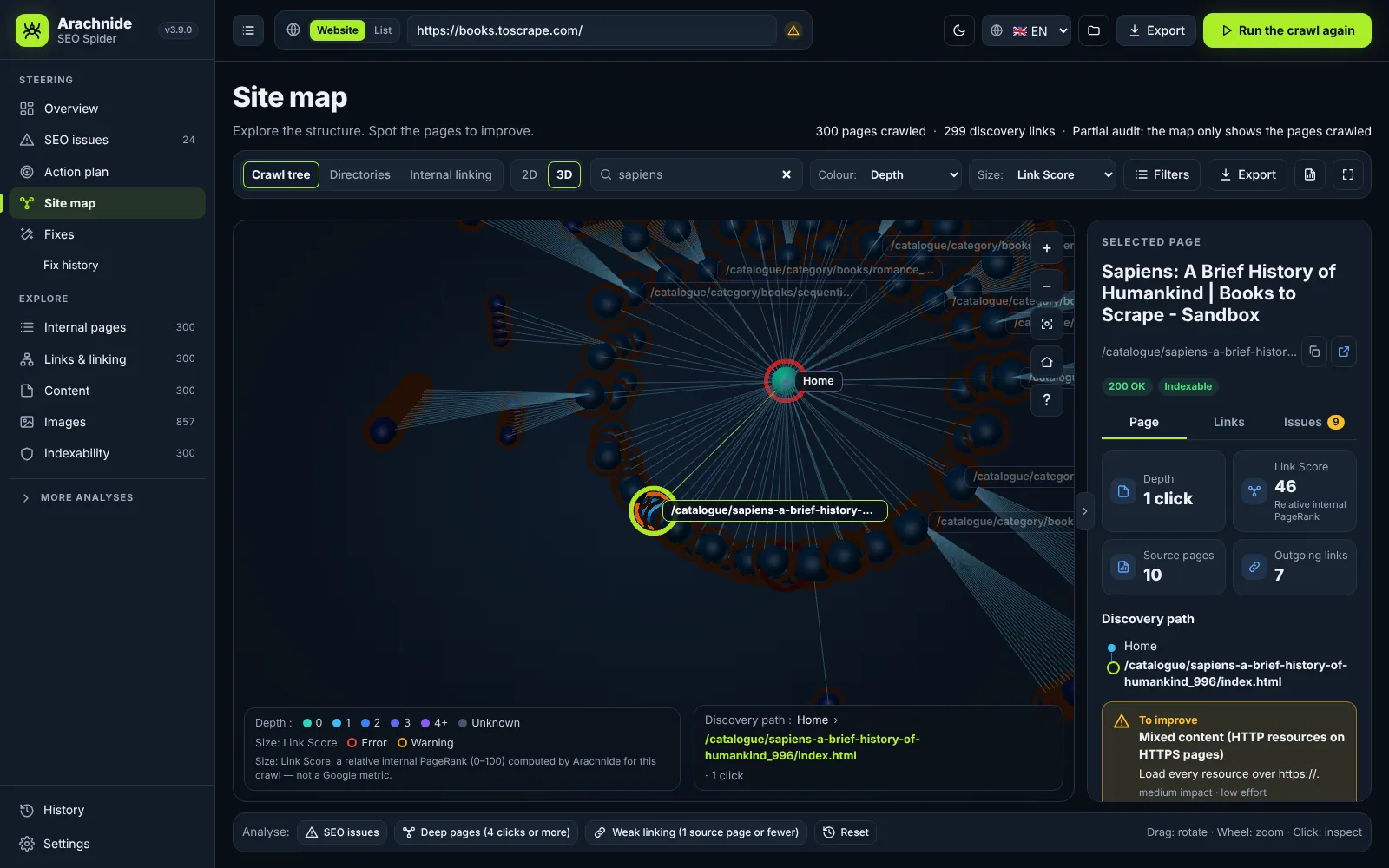
- 2D / 3D visualisation: the exploration view. Dark style, radial layout, 2D or 3D, coloured by SEO issues by default.
Three representations
- Crawl tree: each page under the page it was reached from on the shortest path from the home page, recorded by the engine during the crawl, so the displayed path always has exactly depth clicks. Pages not reached by a followed link are grouped under a virtual Not reached from the home page node, never an invented link.
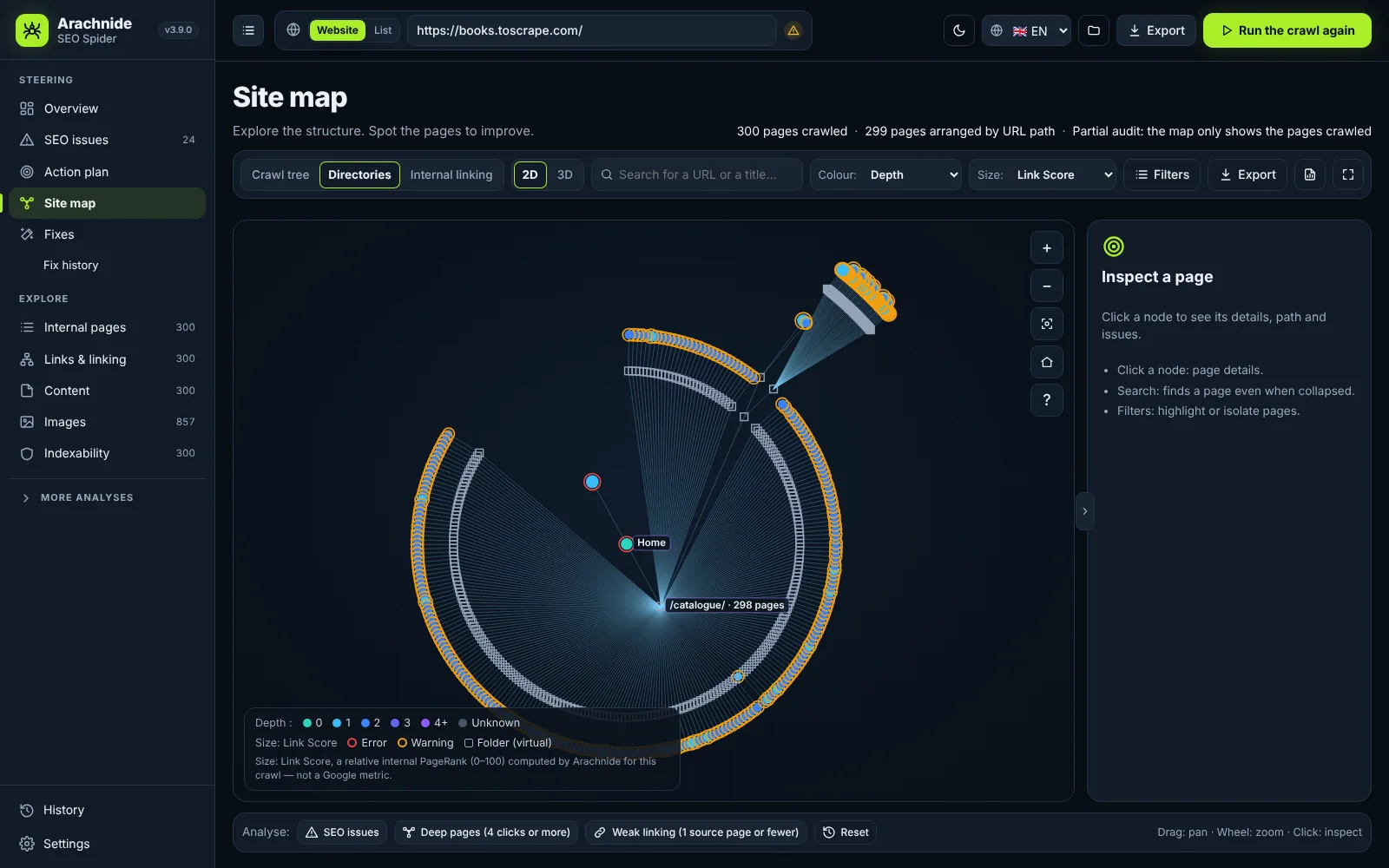
- Directories: the URL path hierarchy. Folders are virtual and never counted as pages; a page whose URL is the folder itself is carried by the folder (
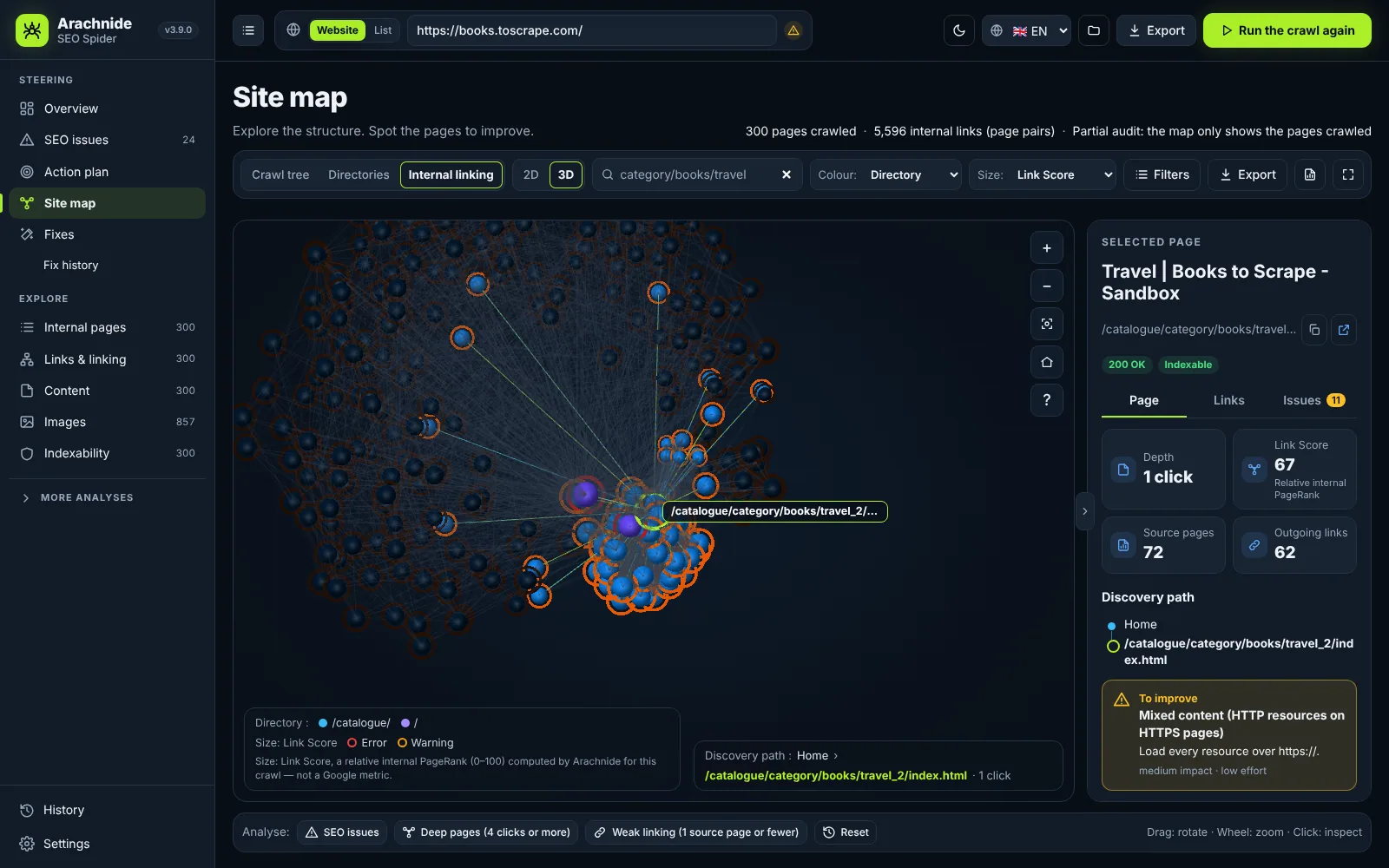
/encarries/en/), and a folder with no page at its own address is labelled as a grouping (/blog/page/*). Labels are relative to the parent folder, like a file explorer. - Internal linking: the real directed links between crawled pages, cycles included, nofollow excluded. Well-linked pages gather in the centre; isolated pages drift to the edge.
Long sibling lists keep their biggest branches and summarise the rest in a + N more pages node that keeps the most serious issue of what it hides; Show the full list expands it. The selected page and its path are always kept.
Colours, sizes and filters
- Colour by: SEO issues (default), depth, HTTP status, indexability (unknown shown as such), directory, or segment when segments are defined; error and warning rings.
- Node size: Link Score (Arachnide's relative internal PageRank, not a Google metric), page weight, inlinks or response time.
- Filters on every crawled page, not only on what is drawn: issues and severity, depth, folder (at any level), URL patterns to include or exclude (plain text,
*wildcard or regular expression, one per line), HTTP status, indexability, weak inbound linking with an explicit threshold, Link Score range. Highlight or isolate; Analyse presets; chips and reset. - Search across all pages expands collapsed groups and frames the page.
- Up to 6 000 nodes drawn; only pages are drawn (images, PDF, CSS and JS are counted and hidden).
Page inspector
Click a node: title, URL (copy, open), status, indexability (only when known), depth in clicks, Link Score, source pages, outgoing links, discovery path, issues with their recommendation; Isolate the branch / neighbourhood, See internal links, See the action plan, Back to the overall view. The inspector loads a page's neighbours on demand, so the browser never receives the whole link graph.
Exports and accessibility
PNG and PDF (A4 landscape) exports keep the labels, the legend and a header with the view, site, crawl date and pages shown; CSV of the pages. A List view gives keyboard access, full screen and a collapsible inspector are available, WebGL-less browsers fall back to 2D, and prefers-reduced-motion is respected.
Performance
Trees use a deterministic layout computed once, not a physics simulation; 3D nodes are drawn as one object with a shader, links as one batch, and nothing is redrawn while idle. Measured on the same machine with software rendering, a 5 000-page 3D tree stabilises in 0.9 s instead of 11.7 s, at 47 frames per second while rotating instead of 1 (details in the changelog, 3.9).