SEO issues and action plan
The issues page, the recommended priority, the fix panel, and the action plan you can work from and track.
Everything Arachnide checks
About 95 checks in 14 families. Each one has an explanation, a fix, a severity (error, warning or notice) and an impact and effort level that drive the action plan.
| Area | Checks |
|---|---|
| Response codes | 2xx / 3xx / 4xx / 5xx, timeouts, URLs blocked by robots.txt, broken internal and external links |
| Redirects | Chains, loops, temporary 302/307 redirects, meta refresh, redirects to the homepage (soft 404), internal links pointing to redirects |
| Titles & metas | Missing, duplicate, too long (in pixels), too short or multiple; title identical to H1; Google SERP preview |
| Headings | H1 missing, duplicate or multiple; no H2; skipped heading levels |
| Content | Word count, thin content, exact and near duplicates, keyword cannibalisation, main keyword per page, text ratio |
| Images | Missing alt text, heavy images, broken images, missing width/height (CLS), every srcset and <picture> file checked (size, status, format), no responsive version, no WebP / AVIF, srcset without sizes |
| Indexing | Canonicals (missing, multiple, pointing to a non-indexable URL), noindex, nofollow, X-Robots-Tag |
| Architecture | Click depth, Link Score (internal PageRank), orphan pages, pages with a single inlink or no contextual link, unreachable pages |
| Sitemaps | Missing sitemap, non-indexable URLs in the sitemap, indexable pages missing from the sitemap |
| International | Invalid hreflang codes, missing return links, missing self-reference, missing x-default |
| Structured data | Types found (JSON-LD, microdata), invalid JSON-LD, properties missing for rich results (Article, Product, FAQPage, LocalBusiness, Course, Event…) |
| JavaScript | Content, links, title, H1, canonical or noindex changed by JavaScript; JS errors; LCP and CLS |
| Performance & security | Response time, HTML size, compression, HTTPS, HSTS, mixed content |
| URLs | Uppercase letters, underscores, parameters, accents, length |
| AI & GEO | Access for Googlebot, Bingbot, GPTBot, OAI-SearchBot, ClaudeBot, PerplexityBot, Google-Extended…; llms.txt |
Checks run on indexable pages where it makes sense (titles, descriptions, H1, images, URLs, hreflang), duplicates exclude hreflang alternates, paginated series and other-language pages, alt="" is a decorative image (a separate notice), a 302 is a notice, and /index.html → / is not a soft 404.
The issues page
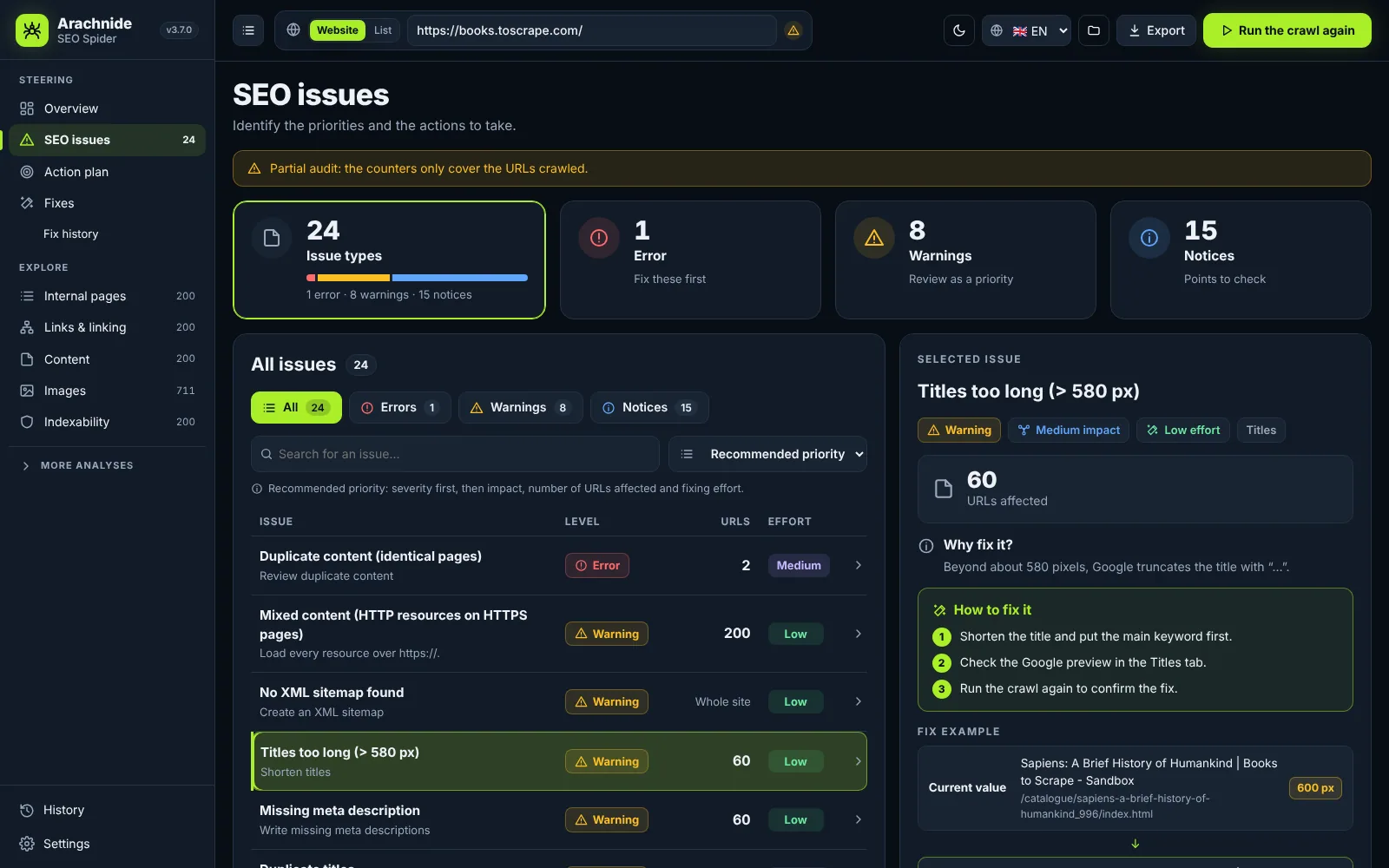
- Summary cards count issue types overall, errors, warnings and notices (never a sum of URLs). Click a card to filter the list.
- The prioritised list has severity tabs, a search on name, category and action, and a sort selector: recommended priority by default, then URLs affected, severity, lowest effort or name. Each row shows the issue with its recommended action, the severity badge, the number of unique URLs (or Whole site) and the effort on its own colour scale.
- The fix panel gives the severity, impact, effort and URLs affected, Why fix it?, numbered How to fix it steps (the issue's own recommendation, a check for its category, then a re-crawl), a before / after example from a real page (with an automatic shortening suggestion for titles and descriptions that are too long, clearly labelled), nuances (decorative images, intentional noindex, short pages), a preview of the affected URLs, See the N URLs (full table with search, pagination and CSV) and Export the list. Prepare the fix opens the Fixes tab when the issue can be fixed there.
- When segments are defined, each issue shows its breakdown by segment.
Recommended priority: errors always come first, then warnings, then notices; inside a severity, issues are ranked by impact × URLs ÷ effort. The same order drives the overview priorities and the action plan.
The action plan
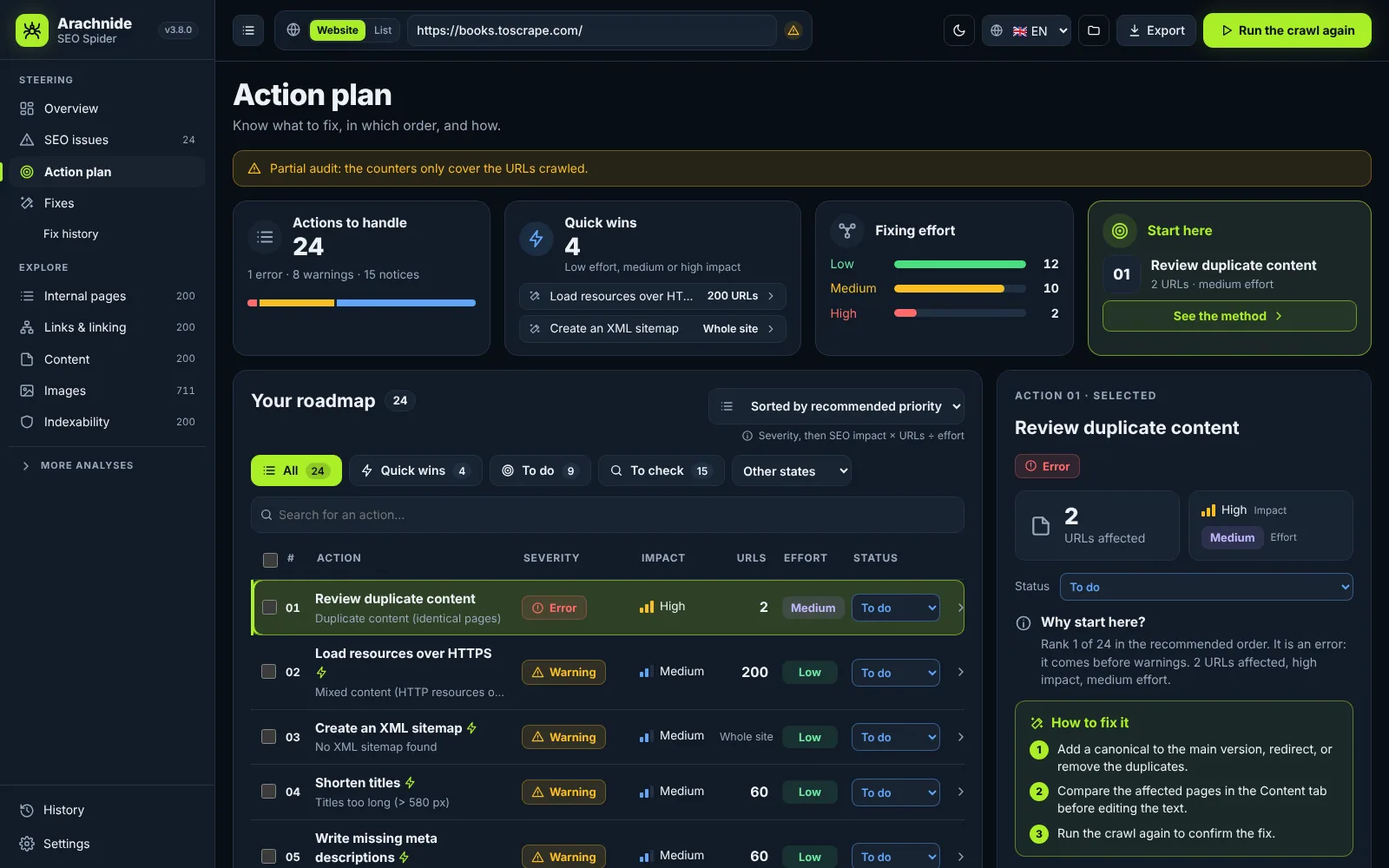
- Four cards: actions left to handle (by severity), quick wins (low effort, medium or high impact), fixing effort, and Start here, the first action in the recommended order, which moves on as actions are handled.
- The roadmap turns each issue into an action with a verb (“Shorten titles”, “Check nofollow links”), its rank, severity, SEO impact, unique URLs, effort and status. Filters (all, quick wins, to do, to check, in progress, to validate), search, and a manual sort that clearly replaces the recommended order until you switch back.
- The action panel explains why to start here (facts from the crawl only), a numbered method, a concrete Done when… criterion (a re-crawl for fixes, a documented decision for notices), see / export the URLs, a note, and the flow To do → In progress → To validate. Only a newer crawl that no longer detects the issue marks it resolved.
- Tracking (status and notes) is saved in your browser per site with stable issue ids; multi-select exports the URLs of several actions or changes their status at once.
Comparing two crawls
Arachnide compares every crawl with the previous crawl of the same site, URL by URL: an issue is fixed only when its URLs were crawled again without it; URLs not crawled again are not rechecked; a warning appears when the two crawls differ by more than 20 % or one was stopped. The comparison appears in the report, in e-mail alerts and in the arachnide_compare_crawls agent tool.